








6 Essential Core Exercises for Pregnant Women – Plus Which Ones to Steer Clear Of
Having a little bean on the way brings a flurry of questions: Can I eat bacon? What type of cheese is on the safe list? Should I even be thinking about ab workouts?
While it may feel counterintuitive to do core exercises when you’re pregnant, it’s actually very important to alleviate back pain, prepare yourself for labor, and speed up your postpartum recovery time.
“Your entire midsection is working so hard to support your growing baby,” says Kim Perry, CPT, a pre- and postnatal certified trainer based in Sarasota, Florida. “I recommend pregnant [people] integrate core work into their fitness routine and focus on the deep core muscles that will help improve your posture and mitigate some of those pesky pregnancy symptoms.”
For instance, the transverse abdominis is a major core muscle that wraps around your stomach and back. It acts like a corset by supporting your core and reducing stress on other various muscles in your abdominal region. It also helps to prevent diastasis recti, in which the left and right sides of your abdominal muscles can split during pregnancy, Perry adds.
Core stability exercises were more effective than usual care in relieving pain and boosting the quality of life for pregnant people with pain in their lower back and pelvic area in a January 2023 study published in the Journal of Manipulative and Physiological Therapeutics.
However, once you’re expecting, you might need to change the type of core exercises you do. It’s important to avoid certain types of core exercises, which include traditional go-to’s like crunches.
“Core exercises are incredibly important during pregnancy, but your focus should shift on how you approach your core work,” says Anna Kaiser, CPT, a pre- and postnatal certified trainer and CEO of Anna Kaiser Studios in New York City. “And depending on the person, you should avoid adding weight or intensity once you get pregnant. Continue working out at the same level you were before getting pregnant.”
Here are the six best core exercises for pregnancy, demonstrated by Perry—plus, three moves to avoid.
Safe core exercises for pregnancy 1. Offset squat
“This move is an anti-tilt challenge for the core,” Perry says.
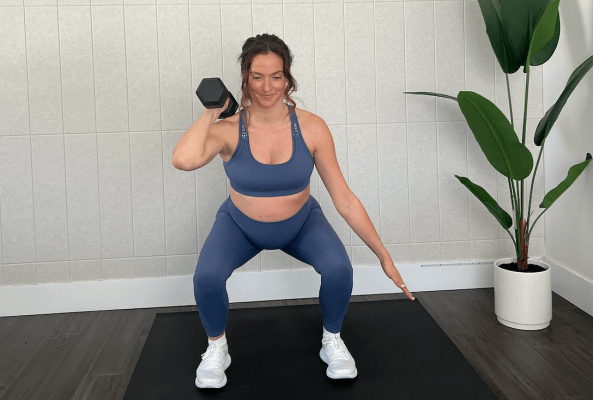 Photo: Kim Perry
- Stand tall with your feet hip-width apart, arms by your sides. Hold a dumbbell in your right hand (palm facing in toward your body).
- Lift the dumbbell up so that the head of the dumbbell rests on your right shoulder, palm facing in.
- Engage your core by drawing your belly button in, as if you’re giving the baby a hug.
- Bend your knees and push your hips back to lower toward the floor. Pretend as though you were going to sit on a chair.
- Lower down as far as comfortable, or until your thighs are parallel with the floor.
- Pause for a moment at the bottom of your squat. Resist the tilt from the extra weight on your shoulder.
- Press through your heels to return to standing.
- Complete 12 to 15 reps on each side.
2. Belly breathing
Also known as diaphragmatic breathing, this is a foundational move for core engagement during and after pregnancy. It may seem “simple” for a core workout, but it actually plays a very important role.
“The movement of your pelvic floor mimics the movement of your diaphragm,” Kaiser says. “If you are breathing into your chest and using your secondary breathing muscles, your neck and chest muscles will get tighter and your pelvic floor will not condition itself as it would if you were focused on deep belly, diaphragmatic breathing.”
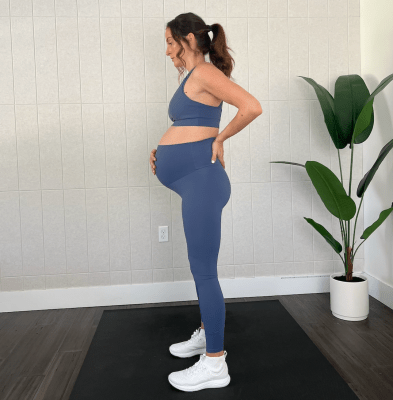 Photo: Kim Perry
- Stand tall with your feet hip-width apart.
- Place your right hand on your belly and your left hand on your hip or lower back.
- Take a deep breath in, filling your belly with air.
- As you exhale, think about first lifting your pelvic floor, then wrap your abdominals like you are gently tightening a corset from hip to hip.
- Complete 5 to 10 reps.
3. Bird dog
The bird dog “requires a lot of focus and stability,” Perry says. “If you notice yourself wobbling, you can bring your toes to the mat for more support.”
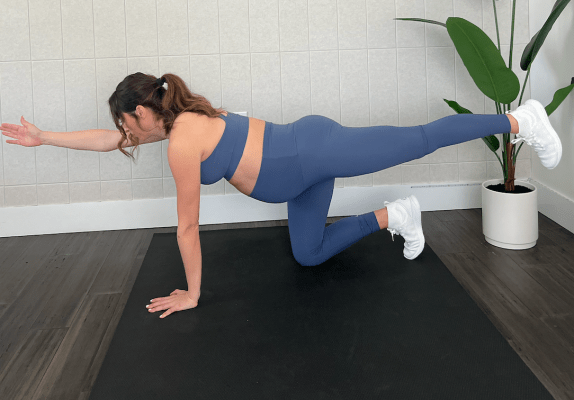 Photo: Kim Perry
- Start in a tabletop position on your hands and knees. Your hands should be directly in line with your shoulders and your knees should be directly in line with your hips.
- Inhale, then exhale to engage your core as you lift your right arm straight out in front of you.
- At the same time, reach your left leg straight behind you, fully extending your knee.
- Pause for a moment, then return to starting position.
- Repeat on opposite side, lifting your left arm up and your right leg back.
- Complete 12 to 15 reps on each side.
4. Side plank abduction
“I love this move for the core, hips, and booty,” Perry says.
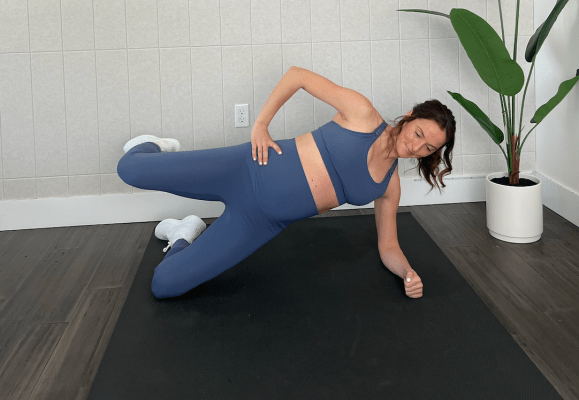 Photo: Kim Perry
- Lie on your left side.
- Prop yourself up on your left forearm with your elbow in line with your shoulder.
- Bend your knees and keep them stacked on top of each other.
- Inhale and relax.
- On the exhale, engage your core and lift your hips up into a plank, raising your top knee.
- Squeeze your glute. Hold for one count and slowly lower down to starting position.
- Complete 12 to 15 reps on each side.
5. Bear hold 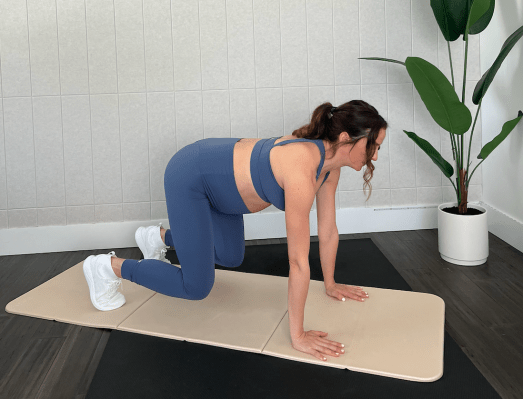 Photo: Kim Perry
- Start in a tabletop position on your hands and knees. Your hands should be directly in line with your shoulders and your knees should be directly in line with your hips.
- Inhale, then exhale and engage your core as you press your palms down and lift your knees off the mat.
- Hover your knees below your hips for 3 to 5 seconds, then slowly lower back down.
- Complete 10 to 12 reps.
Tip: Focus on keeping the hips level the entire time by placing a block on your hips (or simply imagine one there).
6. Offset march
“This is another anti-tilt exercise that focuses on balance and stability,” Perry says.
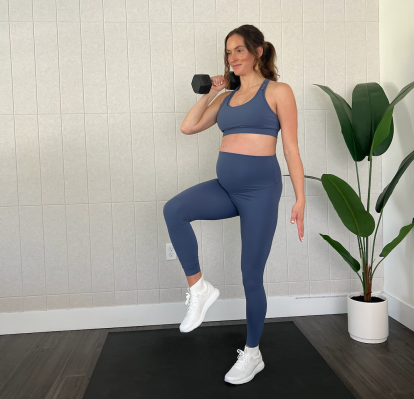 Photo: Kim Perry
- Stand tall with your feet hip-width apart, arms by your sides. Hold a dumbbell in your right hand (palm facing in toward your body).
- Lift the dumbbell up so that the head of the dumbbell rests on your right shoulder, palm facing in.
- Engage your core and shift your weight to your left leg.
- Raise your right knee as if you were marching.
- Slowly lower your right leg and repeat on the other side.
- Complete 12 to 15 reps on each side.
Core exercises to avoid during pregnancy 1. Standard crunch
While they may be a traditional ab workout, crunches are an exercise to avoid when you’re expecting.
“Moves like crunches put pressure on the linea alba, the connective tissue that holds your abs together,” Perry says. “This area is already under stress from supporting a baby and extra stress can increase the chance of tearing the tissue and developing diastasis recti.”
2. Plank
As your pregnancy progresses, you’ll also want to phase out planks, which can put too much pressure on your core.
“If you have been incorporating planks and bodyweight exercises into your programs since before pregnancy, you should stop planking once you get to 22 to 25 weeks of pregnancy,” Kaiser says.
3. Bicycle crunch
“Avoid any quick twisting movements in your torso and extended exercises lying on your back, like bicycles and leg switches,” Kaiser says.
Twisting your torso can crowd the baby’s space, per UNC Health. And spending too much time on your back (including when you sleep) when you’re over 20 weeks pregnant can constrict blood flow to you and the baby, according to the Cleveland Clinic.

Is the Yosuda Exercise Bike (2024) the Ultimate Budget-Friendly Option for Fitness Enthusiasts?
As the maker of some of the best exercise bikes for those on a budget, Yosuda is on a mission to make home fitness equipment accessible to more people. We selected four Yosuda exercise bikes to bring you a taste of what it’s like to pound the pedals on these affordable machines. The BarBend team of certified personal trainers, CrossFit coaches, and gym owners has spent years using over 20 exercise bikes, so when we hop in the saddle, we know what to look for.
We took the Yosuda YB001R Magnetic Exercise Bike for multiple spins and rated this model on a scale from 1 (yikes) to 5 (hooray) across 13 categories, like durability, adjustability, and portability. Whether you need a quiet ride, are short on floor space, or just want to reap the health benefits of indoor cycling — like lower blood pressure and increased aerobic capacity — take a more in-depth look to see if one of these options matches your budget, your space, and your fitness goals. (1)
About Our Expert:
This article has been reviewed by Amanda Capritto, CPT, CF-L1, CES, CSNC a certified personal trainer, certified nutrition coach, and CrossFit Level-1 Trainer. She reviewed the research we cite to help ensure we’re providing helpful, accurate descriptions and recommendations.
Why Should I Buy a Yosuda Exercise Bike?
If you’re tight on space in your home or in your wallet — or both — one of Yosuda’s exercise bikes might be the cardio machine you’ve been looking for. The company is known for packing high quality features — think heavy-duty steel frames and flywheels — into compact footprints, but the brand also boasts a variety of different bike forms. While the average exercise bike can land anywhere from $600 to over $2,000, these four Yosuda bikes all come in between $139.99 and $499.99.
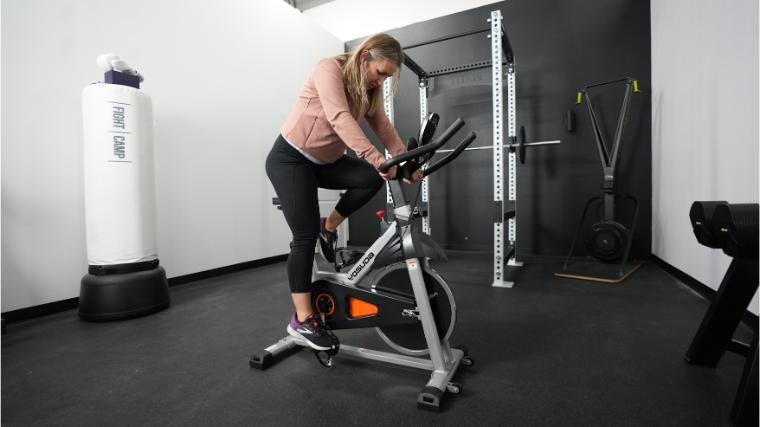 Our tester riding the Yosuda YB001R.
Even beyond their bikes, Yosuda has made an impression in the home fitness world with quality, affordable equipment like rowing machines and treadmills. For all their products, they offer a 30-Day Money Back Guarantee, Hassle-Free returns, fast shipping from local warehouses, and financing options.
We chose four of our favorite bikes from Yosuda and laid out all their details, along with our experience in the saddle, to help you find the model you need to hit your fitness goals. Your choice will come down to three main factors — how much space you can spare, how much cash you can spend, and how many housemates you’re trying not to disturb.
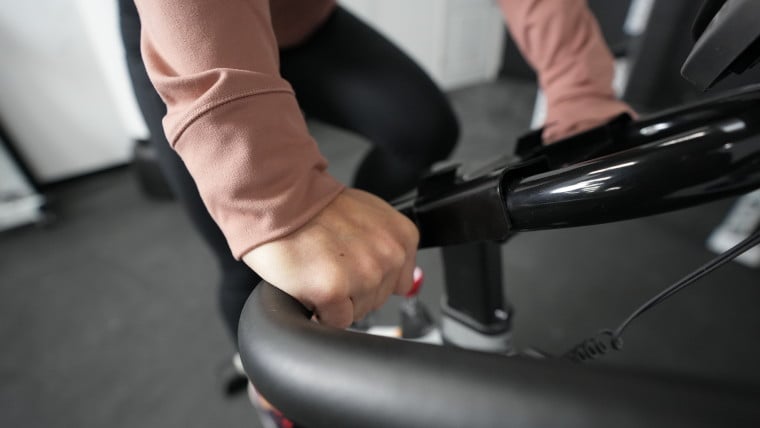 Close look at the handlebars while our BarBend Tester rides the Yosuda YB001R.
The quiet magnetic resistance onboard the YB001R or Pro models will be ideal for those with sleeping babies, cats, or roommates. The friction resistance of the YB001 and YB007A, meanwhile, is a bit noisier, but can save you a few bucks. Among all four options, you’ll see little difference in the floor space they occupy — 6.11 to 6.71 square feet — and a big difference in weight capacity — 270 to 350 pounds.
Over many rides on the YB001R Magnetic Exercise Bike, our team — including our tallest member at 6 foot 3 inches — has become familiar with the build, technology, and overall feel of these similar, but distinct exercise bikes from Yosuda. Check out what the BarBend team of weirdos who love cardio had to say about these four Yosuda exercise bikes.
Main Takeaways
- Yosuda YB001R Magnetic Exercise Bike: With a 35-pound flywheel and magnetic resistance system, if you’re looking for a compact, quiet bike and don’t need a huge weight capacity, this model is for you.
- Yosuda YB001 Indoor Stationary Cycling Bike: At just $233, this is the most affordable option of the four and with a 69-pound overall weight, most users can tilt and roll it from room to room.
- Yosuda Pro Magnetic Exercise Bike: As the most high-end option of the four, it has a weight capacity of 350 pounds, while its extendable tablet holder allows you to stream a workout or show while you ride.
- Yosuda YB007A Indoor Stationary Cycling Bike: As the big brother of the YB001, this model has the largest footprint — 6.71 square feet — but is the most adjustable.
Yosuda YB001R Magnetic Exercise Bike
Yosuda YB001R Exercise Bike
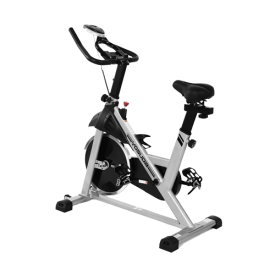
Yosuda YB001R Exercise Bike
Smooth and quiet cycling with a 35 lb flywheel and attached transport wheels so you can cruise where you want to. Simple LCD screen with a lip for an iPad, tablet, or phone.
Shop Yosuda
- Price: $279
- Dimensions: 45” H x 40” L x 22” W
- Weight: 68lbs
- Resistance: Magnetic
- Weight Capacity: 270lbs
- Flywheel Weight: 35lbs
Pros
- With a footprint of just 6.11 square feet and built-in transport wheels, its compact design is ideal for athletes limited on space.
- The 35-pound flywheel uses magnetic resistance to create a quiet ride for users up to 270 pounds.
- Compared to the average price range for upright exercise bikes — $600 to $2,000 — its $279 price point offers tremendous value.
Cons
- The magnetic resistance levels are not listed, so you’ll need to adjust the intensity based on feel.
- During testing, we noted some durability concerns, like small tears in the seat cushion after just a few rides.
When we first got our Yosuda YB001R Magnetic Resistance Exercise Bike, our tester had a one word reaction, “Whew.” After pulling it out of the box, all we had to do was attach the wheels and monitor and it was ready to ride. Delivery and set up was one of three categories, along with its footprint and portability, to earn at least a rating of 4 out of 5 from our tester, a certified personal trainer and nutrition coach.
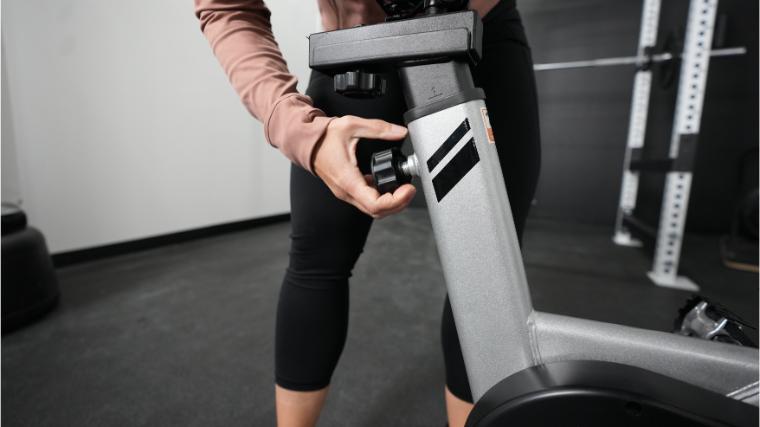 Our tester adjusting the seat stack on the Yosuda YB001R.
Anyone worried about disturbing the neighbors should appreciate the heavy-duty 35-pound flywheel that uses magnetic resistance to generate a quiet ride. “I was surprised at just how quiet it was,” our tester said. At 6 foot 3 inches, they pointed out how easy it was to adjust the seat and handlebars to find a comfortable fit, scoring its adjustability and ergonomics a 3.5 out of 5.
While it lacks Bluetooth connectivity or a screen — the tech capabilities on the YB001R earned a 2 out of 5 — this bike features an LCD display that shows your speed, distance and odometer. You can also slide your own device in the tablet holder to stream your own virtual workouts or shows.
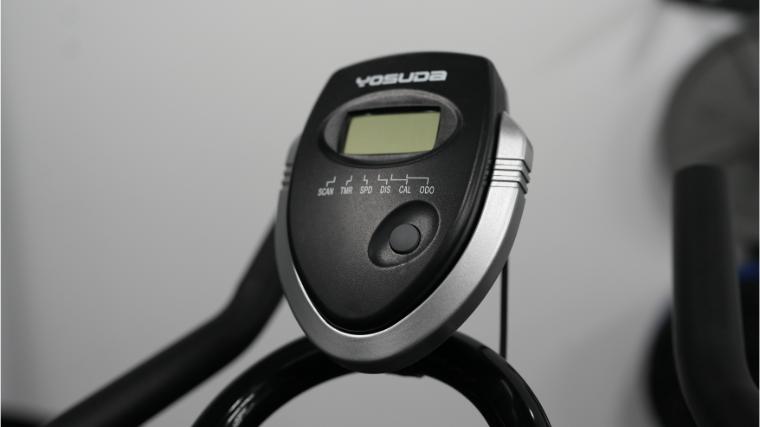 The LCD screen onboard the Yosuda YB001R.
We did notice a few durability concerns, most notably on the seat. “After two of three rides, I could already see some small tears on the seat — not a good sign,” said our tester. Although, for $279, our tester still rated its value 3.5 out of 5. “It may not be someone’s forever bike, but for a quick fix or beginner, this is a great price.”
Yosuda YB001 Indoor Stationary Cycling Bike
Yosuda YB001 Indoor Stationary Cycling Bike
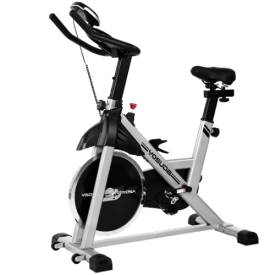
Yosuda YB001 Indoor Stationary Cycling Bike
At just $233, the Yosuda YB001 Indoor Stationary Cycling Bike is the most affordable upright bike from Yosuda and with a 69-pound overall weight, most users can tilt and roll it from room to room.
Shop Yosuda
- Price: $233
- Dimensions: 45” H x 40” L x 22” W
- Weight: 68lbs
- Resistance: Friction
- Weight Capacity: 270lbs
- Flywheel Weight: 35lbs
Pros
- At just $233, it is the most affordable upright bike from Yosuda.
- Its built-in transport wheels and 68-pound overall weight can make it easy for most users to move.
- With a tablet holder beneath the LCD monitor, you can stream workouts or entertainment, while keeping an eye on your metrics.
Cons
- It may best for hard floors, as it can be a bit wobbly on carpet.
- Multiple customers reported that the seat was uncomfortable and needed to be switched out.
The Yosuda YB001 is the most affordable of the four bikes in our review, but with a footprint of 6.11 square feet and 35-pound flywheel, we think anyone looking who is short on space and looking for a challenging ride may have found their match. Our tester — a certified personal trainer and nutrition coach — rated the identical footprint of the YB001R a 4 out of 5. “I thought it was so easy to move. It felt super compact compared to other bikes I’ve tried,” they said.
Given its 68-pound overall weight and dual transport wheels, most people might be able to even tilt and roll it from room to room by themselves. After checking in on customer reviews, however, you may want the room that it ends up in to have a hard floor as opposed to carpet. Several users noted it was more wobbly on a soft surface like carpet.
While the YB001 won’t be mistaken for one of the best exercise bikes with screens, the tablet holder lets you stream workouts or catch up on Love is Blind — how could you, Jeramey?! — while getting your heart rate up. The seat height and handlebars are adjustable to help you find your fit, while the seat can also be switched out if you need a bit more padding.
As the less-expensive version of the YB007A, this model has a lower weight capacity (270 pounds), but occupies nearly one square foot less floor space, as well as less space in your budget. At $233, it’s the least expensive among these four by $46, while still allowing you to track your metrics and reap some of the benefits of cardio, like lower blood pressure. (benefits of cardio) At roughly $370 less than the bottom of the average range for upright bikes — $600 to $2,000 — it brings a lot of value.
Yosuda Pro Magnetic Exercise Bike
Yosuda Pro Magnetic Exercise Bike
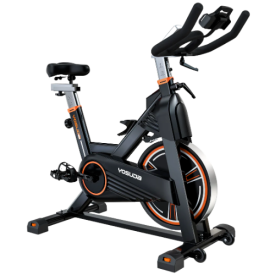
Yosuda Pro Magnetic Exercise Bike
The Yosuda Pro Magnetic Exercise Bike has a weight capacity of 350 pounds, while its extendable tablet holder allows you to stream a workout or show while you ride.
Shop Yosuda
- Price: $399
- Dimensions: 42 H x 41 L x 22 W
- Weight: 86lbs
- Resistance: Magnetic
- Weight Capacity: 350lbs
- Flywheel Weight: 40lbs
Pros
- Using magnetic resistance, the 40-pound flywheel helps create a quiet ride.
- Its 350-pound weight capacity is the highest among all Yosuda exercise bikes.
- The tablet holder can pivot and extend 11 inches.
Cons
- At 86 pounds, it may be a bit too heavy for some to move on their own.
- The LCD monitor is not backlit, which can make the stats difficult to read in low lighting.
Among these four, the Yosuda Pro Magnetic has the highest weight capacity (350 pounds), while using a 40-pound flywheel to create a quieter ride than models with a friction resistance system. Anyone concerned about disturbing neighbors, or sleeping babies may want to give this model a closer look.
The LCD monitor can keep track of your metrics, like speed and distance, but the extendable tablet holder allows you to slide in your own device to stream whatever you like. As that digital monitor is not backlit, it could be a bit difficult to see in low lighting. If you prefer to track your stats or go a virtual ride on one the best fitness apps like Peloton or iFIT, though, you can pivot and stretch the iPad holder up to 11 inches to find the best placement for your intense workout.
Compared to the YB001R model that we tried out, the 18-pound weight difference may preclude some people from moving it on their own, even with the built-in transport wheels. The Pro Magnetic model is the most expensive option among the four in our review by $100, but anyone needing a higher weight capacity and quiet ride, might find that price difference to be worth it.
Yosuda YB007A Indoor Stationary Cycling Bike
Yosuda YB007A Indoor Stationary Cycling Bike
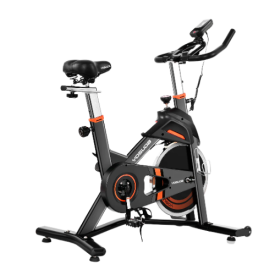
Yosuda YB007A Indoor Stationary Cycling Bike
As the big brother of the YB001, the Yosuda YB007A Indoor Stationary Cycling Bike has the largest footprint — 6.71 square feet — of the Yosuda upright bikes, but is the most adjustable.
Shop Yosuda
- Price: $299
- Dimensions: 45.3 H x 44.5 L x 21.7 W
- Weight: 86lbs
- Resistance: Friction
- Weight Capacity: 330lbs
- Flywheel Weight: 40lbs
Pros
- Its 330-pound weight capacity is 60 pounds more than the similar YB001 model.
- While it uses friction instead of magnetic resistance, it comes in at $100 less than the Pro Magnetic.
- The seat can be adjusted up, down, forward and back, while the handlebars adjust up and down.
Cons
- Its friction resistance system may be a bit noisier than a magnetic system.
- With a footprint of 6.71 square feet, the YB007A takes up the most room of these four bikes.
Compared to the other model in our review with friction resistance (the YB001), the YB007A’s weight capacity is 60 pounds higher, making it more accessible for more users. With a heavier flywheel, and belt-drive system, you can also expect a smooth ride as you build momentum and adjust the resistance.
Speaking of adjustments, the four-way adjustable seat and vertically-adjustable handlebars may also allow more athletes to find a comfortable position on this bike. No matter what position the seat is in, the resistance adjustment knob on the frame will be within reach, just above the water bottle holder. Instead of defined levels, you’ll need to get a feel for how much to turn it to hit your desired resistance.
[Related: Best Exercise Bikes Under $500]
The friction resistance system on the YB007A may be a bit noisier than the magnetic systems on the YB001R and Pro Magnetic models. But unless you are concerned about annoying your neighbors or waking up your cat, popping in your AirPods and streaming a workout or show from your own device is always an option.
With the tablet bracket, popping in your own device to stream a virtual ride, Nelflix, or YouTube TV can help you focus on your sweat, or distract you from it. The LCD monitor is also conveniently placed above the bracket so you can keep an eye on your speed, distance, or calories burned.
What to Consider Before Buying a Yosuda Exercise Bike
While these four Yosuda exercise bikes are similar, there are a few key differences like the amount of floor space they require, the kind of resistance system they use, and, of course, how much they cost. Check out a few things to consider before deciding which one is for you.
Available Space
Two of these bikes — the YB001R and YB001— take up virtually the same amount of floor space: 6.11 square feet. If you can visualize these bikes in your living room, this is about half the size of the average loveseat. (2)
[Related: The 9 Best Portable Exercise Bikes]
Anyone super tight on space may want to decide between these two, but if you can spare just a bit more real estate, the Pro Magnetic (6.26 square feet and the YB007A (6.71 square feet) feature higher weight capacities and heavier flywheels. If the space you have available is your deciding factor, grab your measuring tape and consult the dimensions we included for each bike.
Price
As with any large purchase, establishing your budget should probably be the first step in your search for a Yosuda exercise bike. These options range from $233 to $399, but all of them are below even the low end of the average range among many upright bikes out there — $600 to $2,000. These bikes are some of the best budget home gym equipment that we have tested, so if you are looking for an affordable exercise bike, one of these four could be your match made in exercise bike heaven.
Type of Resistance
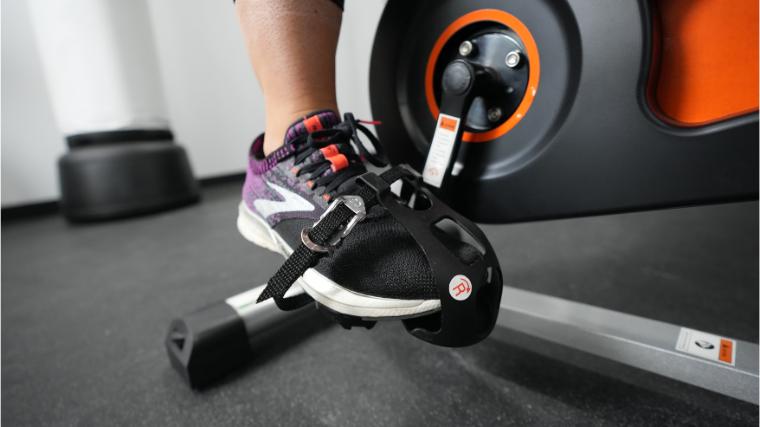
Two of these Yosuda exercise bikes use a friction resistance system, while two use a magnetic system. Friction systems use a brake pad to create — you guessed it — friction between it and the flywheel, so as the resistance level increases (and more friction is created) it’s harder to pedal.


Unlocking the Secrets: How NFL Athletes Enhance Power and Speed through the Force-Velocity Relationship
While many NFL athletes lift at their heaviest during the off-season, due to the fact that they don’t have a packed schedule of football games to maintain, experts like Natalie Kollars, a strength and conditioning coach and founder of Fortis, know that proper strength and conditioning also requires explosiveness and speed. To that end, many athletes also focus on moderate loads, and for good reason.
“Focus on moderate load to maximize power and rate of force development,” explains Kollars in a recent Instagram post in which she worked with Seattle Seahawks running back Deejay Dallas.” This performance specialist, with an MSc in Exercise Physiology and Strength & Conditioning aims to “drive intent” among her football playing clients, rather than simply overload them with barbells. It’s all about the force-velocity relationship.
View this post on InstagramA post shared by Natalie Kollars (@nataliekollars)
The Force-Velocity Relationship
The relationship between the amount of force that a muscle can produce is intrinsically linked to the speed of the muscle contraction. So, as the load increases, the speed of movement will decrease. Training with moderate loads makes sense because football requires athletes to exhibit explosive power in various movements such as sprinting, jumping, and changing direction rapidly. Training with moderate loads can closely mimic the demands of these movements, making the training more specific to the requirements of sports such as football. The definition of a “moderate load” is individual to each player’s strength level, but it will typically be a weight that can be performed 8 – 12 times while maintaining good form.
“The force velocity curve is a tool I refer to when programming for my athletes,” Kollars says. Creating the desired adaptation is all about prescribing the correct stimulus. If the goal is to increase an athletes power capabilities, we need to prescribe a load that falls in the middle of the curve.”
Moderate loads allow athletes to move the weight with a moderate speed, striking a balance between force and velocity. This is ideal for power development, as power is the product of force and velocity. Training with moderate loads enables athletes to generate force while still moving the weight at a relatively high speed, promoting power production. Moderate load training also engages both the fast-twitch and slow-twitch muscle fibers. Fast-twitch fibers are crucial for explosive movements, and by targeting them with moderate loads, athletes can enhance their neuromuscular adaptations, something that is necessary for making gains with explosive power and speed.
Compared to training with heavy loads, which is also thought to improve speed and power, moderate load training puts less stress on the joints and connective tissues. This reduced stress lowers the risk of injuries, allowing highly paid athletes like NFL players to consistently engage in training without compromising their overall health and performance, meaning that when the season begins, a player should be ready to go.