Enhance Your Mobility with These 4 Simple Hamstring Stretches
A few sets of heavy deadlifts and RDL’s will leave your hamstrings sore and extremely tight. Tension in your hamstrings can lead to tight hip flexors, pain in your lower back, and increase your risk of injury. Stretching can help you improve your flexibility, mobility, and help with your athletic performance. We’re going to about a few hamstrings stretches to help loosen your hamstring muscles after your heavy leg day training session.
Hamstring Muscles
The hamstrings are located on the back of the thigh and stretches from your hips to your knees. The hamstrings are responsible for flexion and extension of the knee. Your hamstrings work in unison with your glutes and quadriceps, to provide adequate and fluid movement of your lower body.
Your hamstrings are a collection of three muscles extending from your hips to the back of knees, comprised of the semitendinosus, semimembranosus, and biceps femoris muscles.
Your hamstrings cross two major joints – the hip and the knee, making them more complex than other muscle groups. Together these muscles work to bend your knees, extend the hips, and tilt your pelvis posteriorly. Hamstrings injuries are the most common sports injury, therefore stretching and strengthening your hamstrings can help prevent injuries. Some of the most common injuries are strains, tears, and contusions. These injuries often range from mild to severe, characterized by pain, inflammation, swelling, and restricted range of motion. Therefore, by adding effective hamstring stretches to your training program, can help achieve better functional movement and prevent yourself from strain or injury.
Causes Of Tight Hamstrings
Tight hamstrings can result from a variety of factors, such as poor posture, prolonged sitting, lack of warmups, muscular imbalance, muscle weakness, and poor form while exercising.
Best Hamstring Stretches 1. Inch Worms
Inch worms are a fantastic dynamic hamstring stretch. Dynamic stretches are a controlled movement which adequately preps or warms up your muscles, as opposed to a static stretch, which is achieving a certain range of motion and holding that position. Placing your hands directly in front of your toes, inch worms move from a standing position, and walk your hands no front of you until you’re in plank position. From there you reverse and walk your hands back.
How To Inch Worm
- Start standing with feet hips-width apart.
- Hinge at the hips to fold forward, reaching your palms to the floor in front of you.
- With your core braced and legs straight (but not locked), walk your hands forward to come to a high plank position.
- Pause, then reverse the movement to walk your hands back to your feet and stand to return to starting position
2. Downward Dog
Similar to the inch worm, the down dog is a remarkable and effective hamstring stretch. Down dog is a static stretch that places the hips high and pulls the hamstrings effectively to reduce tightness in your hamstrings.
How To Downward Dog
- Start by standing with feet shoulder width apart
- Place your arms straight down in front of your toes and get on all fours in a tabletop position.
- Walk your hands out and lift hips up and back, gently straightening legs to move into downward dog.
- Bend both knees slightly, reaching your tailbone and pelvis toward the ceiling and belly button tucked
- Hold for 10 seconds, trying to lift and set your heel all the way on the ground
3. Standing Hamstring Scoop
A dynamic stretch, the standing hamstring scoop is a great warm up stretch before heavy lifting or a sweat infused high-intensity interval workout. The hamstring scoop places tension on your hamstrings and is a great stretch to loosen your hamstrings before exercise.
How To Hamstring Scoop
- Stand with your feet hips-width apart.
- Shift your weight into the left foot and extend your right leg slightly forward so your heel rests on the floor.
- Reach your arms diagonally toward your right foot and sit your hips back, and bend left knee until there’s a stretch in the right hamstring.
- Hold for 10 seconds.
- Switch sides, repeat and walk for 10 reps.
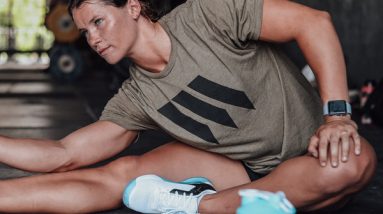
4. Seated Single Leg Hamstring Stretch
You probably learned this hamstring stretch in middle school PE class. The seated single leg hamstring stretch is effective and one of the best hamstring stretches to help reduce tightness and tension in the hamstrings, for better flexibility during your workout.
How To Seated Single Leg Hamstring Stretch
- Sitting, stretch one foot in front of you, with the other folded in, foot flat against, your inner thigh.
- If you can, grab your toe with the same arm of the stretched out foot (right with right).
- Breath out and try and get your chest down to your knee and stretch.
- Breath in, release and come back to starting position
- Repeat and hold for 3-5 reps, then switch sides.
Hamstring Stretches: Takeaway
Your hamstrings are the most susceptible muscle to injury. Stretching your hamstrings, is critical to overcome inhibited performance due to muscle soreness, tightness, and tension. The hamstrings are the central connector to several prominent and integral components to your movement, including your hips, pelvis, low back, and knees. Tight hamstrings can create pain and inhibit movement and athletic performance. Stretching your hammies is crucial to adequately warm up and cool down for proper movement and performance.
Need Help With Optimizing Your Diet, Nutrition, And Training Plan To Finally Get The Results You’ve Been Waiting For?
The Swole Kitchen provides 1:1 nutrition coaching, macro coaching, and custom meal plans to help guide you to becoming the best version of yourself. We teach you how to enjoy the foods you love in the right amounts, so you can fit into your favorite pair of jeans, hit your health and fitness goals, and be healthy and happy. We guide you through making sound nutritional decisions and teach you along the way, so you can learn how to take control of your health, and discover what if feels like to live again.

SWOLVERINE IS AN ENDURANCE ATHLETE AND ACTIVE LIFESTYLE BRAND. MADE FOR THE ELITE ATHLETE, AND THE STRONG-WILLED OUR PRODUCTS WERE DESIGNED TO FUEL YOUR ATHLETIC PERFORMANCE. WE PERFORM WHEN YOU PERFORM.
We believe that everyone can optimize not only their athletic performance but their human potential. The way we believe we can optimize performance is through transparency, clinically effective doses, and clinically proven ingredients with evidence-based outcomes. We provide the nutrients you need to power your active lifestyle.



Limitless X’s Jas Mathur Receives World Boxing Council Championship Belt as a Remarkable Accomplishment
In the thrilling arena of professional boxing, the World Boxing Council’s (WBC) Championship Belt is a highly sought-after symbol of excellence. Thousands of passionate boxers worldwide aspire to obtain this prestigious award, yet only an exceptional few manage to attain this elusive honor. The coveted belt represents a culmination of tremendous effort, dedication, and talent – disciplined traits that must be mastered in order to wear this belt. Recently, Jas Mathur, CEO of Limitless X Inc., joined the ranks of these honored champions – an achievement that showcases the unique intersection between business excellence and the spirit of competitive sports.
The Championship Freedom Belt, as it’s fondly known, was presented by none other than boxing legend Floyd Mayweather and Mauricio Sulaimán, the respected President of the WBC. But they weren’t the only luminaries in the room, the esteemed Robert F. Smith, founder, chairman, and CEO of Vista Equity Partners, was a fellow recipient of this prestigious award.
This rare and prestigious accolade shines a spotlight on the exceptional strides Mathur has taken in the industry, recognizing his unwavering and steadfast dedication to pushing the boundaries of what’s possible while challenging and inspiring the rest to follow suit. The achievement is an undeniable sign of universal admiration, applauding him as a true game-changer in the sector.
The World Boxing Council’s 60th-anniversary celebration provided the perfect backdrop for this award. It was a moment not just for reflection, but also for acknowledging the extraordinary. As a part of this ceremony, the WBC celebrated Juneteenth Black History and recognized the visionary leadership of Mathur and Limitless X. The Council applauded their significant contributions to the sporting and business communities, marking a watershed moment in both arenas.
Often seen as the zenith of professional boxing recognition, the WBC is one of four major organizations, alongside the World Boxing Association (WBA), International Boxing Federation (IBF), and World Boxing Organization (WBO), that hold the power to sanction high-profile boxing bouts. The interconnected histories of these four pillars of professional boxing reach back several decades, and their legitimacy is mutually recognized.
The championship belt, resplendent in green and gold, serves as a tangible symbol of excellence and continuous improvement. The WBC emblem embedded in it mirrors a commitment to transparency and advancement, setting the gold standard for industry-wide recognition.
Reacting to this unparalleled honor, Mathur conveyed his heartfelt appreciation with a few words, “This recognition is not just a personal achievement, but a reflection of the incredible team at Limitless X. We continuously strive to redefine the boundaries of what is possible and remain committed to delivering unparalleled experiences that leave a lasting impact on our audiences.”
Limitless X is not any average lifestyle agency. As a creative powerhouse, it specializes in the full spectrum of digital advertising and marketing. With a global ecosystem and unique product and service-oriented businesses within three verticals, the company has made significant strides in the Health & Wellness, Beauty & Skincare, and CBD industries.
This extraordinary honor, according to Jas Mathur by the World Boxing Council, underscores the alignment of Limitless X’s innovative vision with the Council’s ideals of excellence, transparency, and continuous improvement. The Championship Freedom Belt is not merely a token of recognition, but an ongoing challenge – a challenge to maintain high standards and to keep pushing the boundaries of what can be achieved. It’s safe to say, with Mathur and Limitless X, the future is limitless indeed.
M&F and editorial staff were not involved in the creation of this content.



Building Bigger Arms: Comparing Hammer Curls to Biceps Curls
It’s go-time for your upper body. You’re ready to hit your biceps with enough chin-ups and curls to get the best pump you can. But once you pick up the dumbbells, you pause and contemplate: hammer curls versus biceps curls. Which is going to give you the most effective arm gains?
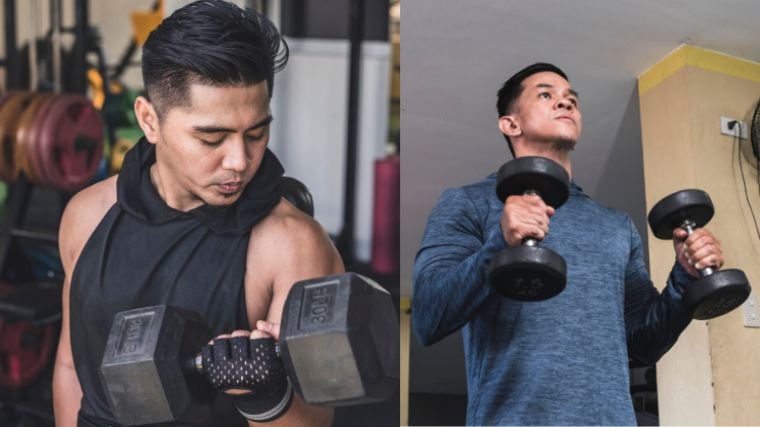
There’s a reason that the dumbbell biceps curl has been a staple go-to for gymgoers for decades. It’s easy to grab a pair of dumbbells, take them anywhere in the gym (but not the squat rack, please), and get a good pump going.
 Credit: MDV Edwards / Shutterstock
But if you’ve been steadily curling for a while, you may consider switching it up with hammer curls. Simply changing to a neutral grip alters the mechanics, muscles worked, and potential outcome of your curls. Here, you’ll learn all about which lift you should choose, and when.
Editor’s Note: The content on BarBend is meant to be informative in nature, but it should not be taken as medical advice. When starting a new training regimen and/or diet, it is always a good idea to consult with a trusted medical professional. We are not a medical resource. The opinions and articles on this site are not intended for use as diagnosis, prevention, and/or treatment of health problems. They are not substitutes for consulting a qualified medical professional.
Table of Contents
- Key Differences
- Key Similarities
- Muscles Worked
- When to Do Hammer Curls
- When to Do Biceps Curls
- How to Do Hammer Curls
- How to Do Biceps Curls
- Benefits of Hammer Curls
- Cons of Hammer Curls
- Benefits of Biceps Curls
- Cons of Biceps Curls
- FAQs
Key Differences
If you use them correctly, both types of curls can help you forge bigger arms. But they’re not exactly the same thing. Changing your grip makes a big difference in emphasis, and therefore in what kinds of results you’re likely to see.
- Hammer curls use a neutral grip with your palms facing each other. Biceps curls use a supinated grip with your palms facing up.
- Because of the grip, hammer curls work your forearms and outer biceps muscles (long head). Although your forearms also contribute, biceps curls isolate your inner biceps muscles (short head) more effectively.
- Since hammer curls require more extensive buy-in from your forearms, they can give your overall arms a thicker appearance. Biceps curls dramatically emphasize your biceps for that rounded biceps look when you flex.
- The neutral grip of the hammer curl allows more of a “rest” at the bottom of each rep. On the other hand, the palms-up position of a biceps curl puts more tension on the biceps at the bottom of each rep.
- Because of this brief rest, the emphasis on a larger amount of muscle mass, and the neutral grip, many lifters can heft bigger dumbbells with hammer curls than biceps curls.
[Related: The 20 Best Biceps Exercises for Greater Growth]
Key Similarities
Changing the grip doesn’t change everything about these lifts. Both are still tremendous accessory exercises that can help bring your biceps to the next level.
- The hammer and biceps curls both increase strength and stimulate hypertrophy in your biceps.
- Both exercises work your pulling muscles, which can carry over to your other lifts.
- Hammer curls and biceps curls are some of the best grip strengtheners that focus on your biceps.
- Both moves help to stabilize your wrists.
Muscles Worked
Both exercises work your biceps brachii muscles. Your biceps brachii consist of a long head and a short head. (1)
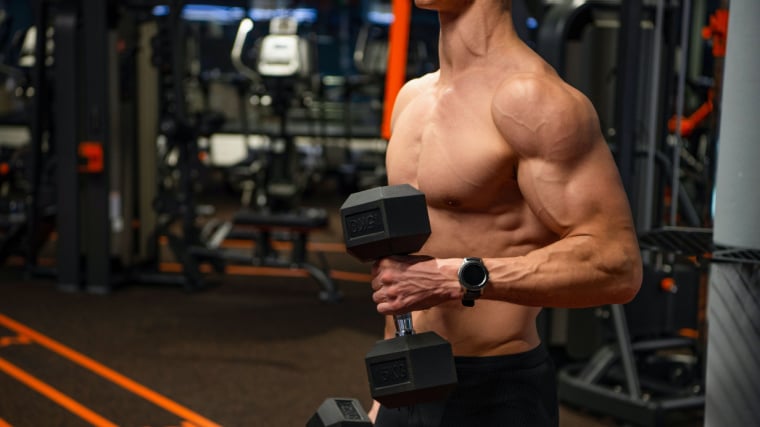
Hammer curls work your biceps brachii and emphasize the long head. They also work your brachialis and brachioradialis muscles. Your brachialis is on your outer upper arm and is your strongest elbow flexor — it’s responsible for bending your arm at your elbow. (2)
Your brachioradialis is located on your outer forearm. You might associate this one with oft-sought-after forearm thickness. It plays a big role in flexing your forearm and elbow — so it’s not just about aesthetics. (3)
 Credit: Just dance / Shutterstock
[Read More: 12 Best Supplements for Muscle Growth of 2023]
For their part, biceps curls specifically work your biceps brachii and focus more on the short head. These muscles work to flex and supinate your forearm. (1)
Your biceps brachii also assist in shoulder stability. Biceps curls can strengthen and grow your inner upper arms — think, being able to keep steady at the bottom of a chin-up. Although your brachialis assists in flexing your elbows, it is not targeted as much as it is in hammer curls.
When to Do Hammer Curls
Deciding when to do each type of curl comes down to what you’re trying to get out of your training. Here are a few situations when hammer curls may be the better choice.
You Want Overall Thicker Arms
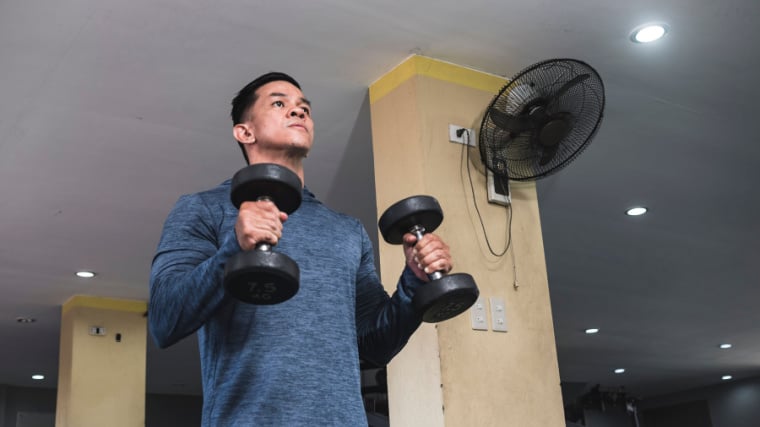
Athletes in pursuit of bigger arms need to break out the hammer. Since hammer curls work the muscles on the lateral part of your upper and lower arms, this lift can give your arms an overall thicker, wider, and larger appearance.
Vary Your Biceps Training
Adding variety to your training program is one way of applying the principles of progressive overload. Performing variations on exercises you’ve been doing for a while can help you break through strength training plateaus, target different muscles, and prevent overuse or injury.
 Credit: MDV Edwards / Shutterstock
[Read More: The 15 Best Triceps Exercises for More Mass and a Bigger Bench Press]
If you’ve been doing classic biceps curls and want to try a variation, try swapping in hammer curls during your next training block.
Recovering From Injury
Biceps curls can be tough on your shoulders and wrists when you go heavy. Switching your grip in hammer curls can spare your shoulders some extra strain while recruiting more muscles to assist your curls.
And if you’re already recovering from wrist, elbow, or shoulder injuries, the neutral grip in hammer curls may be more comfortable than the supinated grip in biceps curls. That’s because it changes the position of your shoulders.
With clearance from a medical professional, you may want to restart your journey with hammer curls. Still, you’ll have to go a little lighter to rebuild your strength.
When to Do Biceps Curls
Biceps curls have been popular for decades for a reason. Here are a few times they might be the optimal choice.
You Want Rounder Biceps
If the upper part of your T-shirt is your biggest concern, standard biceps curls are a solid choice. Biceps curls isolate, target, and build up that classically round peak of your inner biceps.
In addition to dumbbells, you can do biceps curls with a barbell or curl bar. That means you can go a lot heavier with them, potentially increasing your hypertrophy potential.
Improve Your Pull-Up and Chin-Up
If you’re aiming to get your first pull-up or increase your training volume, biceps curls help you purely strengthen your biceps. So if you’re trying to master your first pull-up, biceps curls can be a big help.
[Read More: The One-Month-Long Beginner Pull-Up Program]
Of course, you’ll also have to seriously work on strengthening your back — but you also want your biceps to come in clutch and help you out.
Biceps curls target your biceps to flex your elbows which is one of the joint actions in a pull-up. With biceps curls, you’ll repeat this movement pattern and get your body ready to fully extend your arms under pressure.
You Need Accessibility
Biceps curls are an accessible exercise for older folks, beginners, or anyone returning to exercising after a period of inactivity. You can do them while seated and start with very light dumbbells.
Hammer curls can also be accessible for this reason. But biceps curls are more of an isolation exercise that doesn’t require as much grip strength or use of other muscles.
[Read More: Bodybuilding For Beginners — Your Ultimate Guide for Getting Started in the Gym]
It’s also not just about beginners. Advanced lifters navigating a crowded gym or working out from home can grab dumbbells and grow their arms without much fuss.
How to Do Hammer Curls
Here’s a step-by-step breakdown of how to do your hammer curls with good form to avoid or train through injury and get the most out of your work.
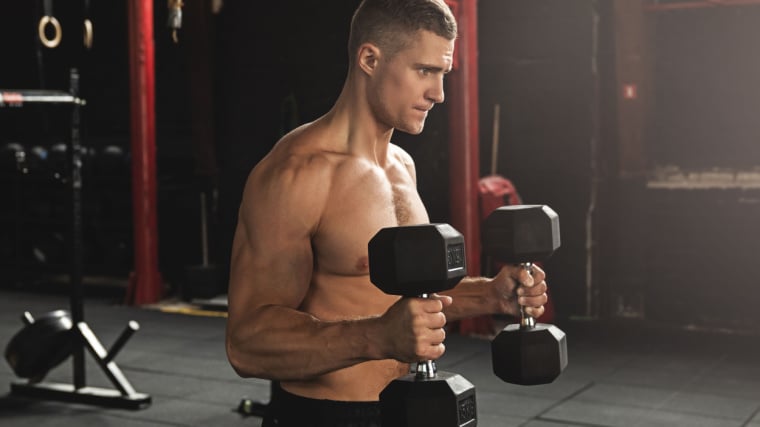
- Inhale to brace your body. On an exhale, curl your weights toward your shoulders by bending your elbows and maintaining a neutral grip.
- Squeeze your biceps and hold for a moment at the top.
- Slowly lower down and focus on eccentric arm training by controlling the lowering portion. You’ll be lengthening of your biceps, brachialis, and brachioradialis.
- Maintain core tension throughout the lift. Try to use control and not momentum. Repeat for your desired number of reps and sets.
What You Need
You will only need yourself and a pair of weights. Dumbbells are generally the most accessible way to perform hammer curls. But you can also use resistance bands, kettlebells, or a cable machine.
Setting Up
Grab your weights. Stand tall with your feet shoulder-width apart. Extend your arms fully straight by your sides. Hold your weights with a neutral grip and palms facing each other. Stand with your hips tucked, glutes squeezed, and abs engaged. Keep your shoulders depressed, spine neutral, and chest up.
How to Do Biceps Curls
Follow these steps to hit your biceps curls with good form.
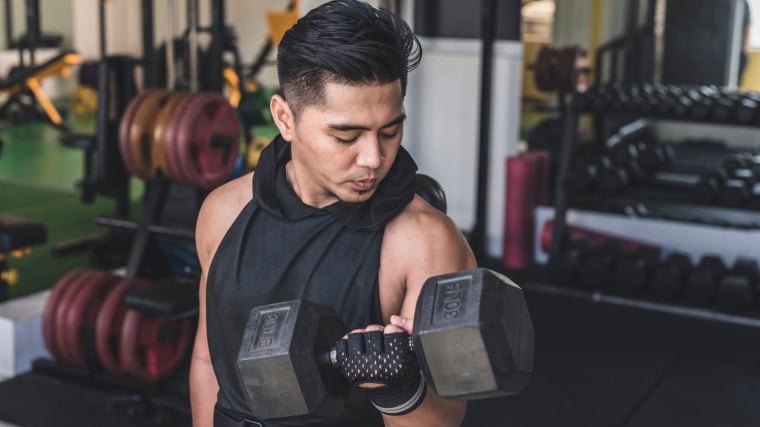
- Inhale to brace and then exhale as you curl your weights up towards your shoulders, flexing at your elbows and keeping your palms face up. Keep your wrists neutral throughout the movement.
- Squeeze your biceps at the top and hold.
- Lower your weights slowly and feel the stretch through your biceps as you straighten your arms. Keep your wrists neutral and don’t let your weights pull them into extension.
- Keep your shoulders depressed, wrists neutral, and core engaged. Move with control and try not to be led by momentum. Repeat for your desired set and rep range for your goal.
What You Need
You just need yourself and a pair of weights for hammer curls. Use dumbbells, kettlebells, or a cable machine. You can also do barbell curls or do the move with an EZ bar.
Setting Up
Choose your equipment and grab it. Stand tall with your feet shoulder-width apart. Extend your arms fully straight and keep them close to your body.
 Credit: MDV Edwards / Shutterstock
Hold your weights with your palms facing up. Stand in a line of tension with your hips gently tucked. Squeeze your glutes and engage your core. Depress your shoulders, maintain a neutral spine, and keep your chest slightly up.
Benefits of Hammer Curls
Some of the best biceps exercises have an extra-special oomph for other muscle groups. The hammer curl is one of these, as it packs an extra wallop for your forearms. Here’s how these neutral-grip curls can help you out.
Builds Brachialis and Brachioradialis
Hammer curls uniquely target your outer arm muscles on your upper and lower arm. This is beneficial for aesthetic goals as it can help give your arms a larger, thicker, and wider appearance. This also gives you a more balanced look when you are growing your arms than solely targeting your inner biceps.
Potential to Lift Heavier
Hammer curls and biceps curls are both single-joint exercises, but hammer curls recruit more muscles to perform the joint action. If you use dumbbells in both hammer curls and biceps curls, you may be able to lift a bit heavier over time with hammer curls. That’s because your outer arm muscles are assisting in the lift.
 Credit: BLACKDAY / Shutterstock
[Read More: How to Deadlift 500 Pounds (and More)]
Hefting more weight can lead to the potential to build muscle and strength in your program over time.
Increase Functional Grip Strength
Hammer curls can build more functional grip strength than biceps curls. Because you’re using a neutral grip, the movement pattern is similar to grabbing, lifting, and carrying objects like heavy groceries.
Having strong forearm muscles can carry over to activities of everyday life, as well as other sports, athletic activities, and heavy lifts.
Cons of Hammer Curls
Though it can be a functional exercise with aesthetic benefits and the potential to grow, it can be really tough for some folks to start.
Tough on Grip
On the flip side of hammer curls being great to improve your grip strength, they also require a lot of grip strength to be able to do them properly in the first place. If your forearm muscles haven’t been worked much before, your grip may give out even before your biceps do.
You may want to start with a pair of lighter dumbbells than you expect. But with patience and consistency, you’ll be able to reap the benefits of grip strength.
Won’t Grow Round Biceps Alone
Hammer curls target your outer arms, which will indeed help round off your biceps. But they’re not enough on your own. Hammer curls don’t emphasize and tax your inner biceps as much as biceps curls. You’ll need to combine these with other movements to stimulate maximum growth.
[Read More: The 11 Best Supplements for Bodybuilding (2023 Update)]
If you only have time for one isolation exercise and your goal is big, rounded, inner biceps, you might want to opt for biceps curls.
Limited Equipment
Due to the nature of a neutral grip, you can’t really do hammer curls with a barbell. You can grab a multi-grip camber bar if your gym has one, but many do not. So, you might be limited to dumbbells. If you prefer curling with a barbell, you’ll likely have to stick with the supinated biceps curls.
This may limit your progression in hammer curls, but there are other ways to progress exercises besides continually adding load. You can try tempo training with hammer curls to emphasize the eccentric portion and get a greater stretch.
Benefits of Biceps Curls
Biceps curls are pretty straightforward — they increase the size and strength of your biceps. This can be beneficial for physique and aesthetic goals as well as the overall strength, health, and stability of your upper arms and nearby joints.
Aesthetic Gains
Your inner biceps can be some of the most pronounced areas of your arms. With biceps curls, you’ll isolate your biceps muscles to elevate your flexing that much closer to Arnold’s.
Whether you’re a competitive bodybuilder or a weekend warrior who..